


https://www.youtube.com/watch?v=3eSgK6HRULE
https://www.youtube.com/watch?v=1P_hj2cjAHI
https://www.youtube.com/watch?v=i2EPcE_Arog
https://www.youtube.com/watch?v=PXk24de42kE
https://search.alexanderstreet.com/preview/work/bibliographic_entity%7Cvideo_work%7C2390365
https://www.youtube.com/watch?v=xEHh84Ptvaw
https://search.alexanderstreet.com/preview/work/bibliographic_entity%7Cvideo_work%7C2390372
블라디미르 아쉬케나지 - 거장 음악가
- The Vital Juices are Russian
- Ashkenazy the conductor
- Ashkenazy on musical gifts
- Rachmaninov: Corelli Variations, Op. 42 (with introduction)
▶ 위대한 피아니스트이자 지휘자, 블라디미르 아쉬케나지의 모든 것
러시아 출신의 피아니스트이자 지금은 지휘자로 더 유명한 블라디미르 아쉬케나지(1937~)는 1963년 연주 여행 중에 조국으로 돌아가지 않고 영국에 망명했다. 그다음엔 아내의 나라인 아이슬란드에 거주하면서 그곳 국적을 취득했고 지금은 스위스에서 살고 있다. 음악 다큐멘터리 전문 감독인 크리스토퍼 누펜은 아쉬케나지의 망명 초기부터 그에게 관심을 가지고 꾸준한 기록을 축적했다. 그때 이미 쇼팽 콩쿠르 2위(1955)를 시작으로 퀸엘리자베스 콩쿠르(1956)와 차이코프스키 콩쿠르(1962)까지 석권한 세계적인 피아니스트였던 것이다. 본 영상물은 하나의 다큐멘터리가 아니다. 영국 체류 시절의 51분짜리 기록을 비롯하여 지휘자로서의 아쉬케나지를 조망한 자료, 음악에 대한 그의 생각을 피력하는 짧은 인터뷰, 라흐마니노프의 장대한 피아노곡 ‘코렐리 주제에 의한 변주곡’에 대한 본인의 해설과 연주, 여기에다가 푸짐한 보너스로 크리스토프 누펜의 다양한 다큐 자료 중에서 편집한 39분짜리 ‘알레그로 필름 컴필레이션’이 추가되어 있다.
“A retiring man who comes vividly to life when at the keyboard. His personality spills out of the film.” - Daily Telegraph
“건반에 있을 때 생생하게 살아나는 은퇴한 남자. 그의 성격이 필름에서 흘러나온다.” - 데일리 텔레그래프
“A boyish figure... who, at the keyboard, becomes a flailing titan.” - The Guardian
“소년 같은 모습... 건반에서는 팔을 휘젓는 거인이 된다.” - 가디언지

The Vital Juices are Russian 1970
[Beethoven 6 Bagatelles, Op. 126 No. 4 in b]
[베토벤 바가텔 작품 126-4]
His name is Ashkenazy: 31 years old, an artist, a traveller, and a Russian.
그의 이름은 아쉬케나지로, 31세의 예술가이자 여행가이자 러시아인입니다.
The Vital Juices are Russian
필수적인 즙은 / 생명의 주스는 / 중요한 본질은 / 원료는 러시아산
Vladimir Ashkenazy: Sometimes it happens for a few bars just to feel: “just that’s right.”
블라디미르 아쉬케나지 : 때때로 몇 마디를 연주하고 이렇게 생각합니다. “맞아, 그거야.”
[Beethoven 6 Bagatelles, Op. 126 No. 4 in b]
[베토벤 바가텔 작품 126-4]
Vladimir Ashkenazy: It really happened so seldom. Terrible.
블라디미르 아쉬케나지 : 그러나 그런 일은 거의 일어나지 않는데요. 끔찍해요.
[Beethoven 6 Bagatelles, Op. 126 No. 4 in b]
[베토벤 바가텔 작품 126-4]
He was born in Gorky in the USSR in 1937, the son of a professional light music pianist. He grew up in Moscow, where he studied at the famous 10-year music school, but since 1963 he has lived in the West almost constantly on tour, a Russian with an Icelandic wife and a house in London but no real home and still very much a Russian.
그는 1937년 소련 고리키에서 전문 경음악 피아니스트의 아들로 태어났습니다. 그는 모스크바에서 성장하여 그곳에서 유명한 10년제 음악 학교에서 배우기 시작했지만, 1963년부터 서방에서 살았으며 거의 끊임없이 순회공연하고 있습니다. 아이슬란드인 아내가 있는 러시아인으로 런던에 살고 있지만, 실제 집은 없으며 여전히 매우 러시아적이죠.
Vladimir Ashkenazy: I feel that I come from the Russian culture background. I feel that, you know, the vital juices in me come from Russia, uh, but, ah... I’ve... I believe... I, I hope that I’ve developed further than just being inspired by the Russian cul... Russian culture background because, uhm, perfo... performing art can’t really be in frames of one country’s culture background, but I find myself... if I hadn’t been in the West for these five years probably I wouldn’t got even where I am now because you simply have to be in the atmosphere of the great masters of the past who wants to in this music. My family still lives in Russia so I have some kind of practical ties, yes, of course. I correspond and I write to my friends but I don’t go there.
블라디미르 아쉬케나지 : 저는 러시아 문화 배경을 가지고 있다고(제가 러시아 혈통이라고) 느낍니다. (저는 제 뿌리가 러시아 문화에 있다고 생각합니다.) 저의 중요한 본질이 러시아에서 온 것 같지만, 아... 전... 전 제가 가진 걸 믿어요... (제 필수적인 즙이 러시아인이라고 느끼죠.) 하지만 저의 발전이 단순히 러시아 문화 환경에서 영감을 받는 것에 국한되지 않았으면 합니다. (제가 단지 러시아 문화에서 영감을 받는 것보다 더 발전하기를 바랍니다.) 공연 예술은 한 국가의 문화라는 틀 안에서만 일어나서는 안 되기 때문이죠. (하지만 제 러시아 문화의 뿌리가 주는 영감을 넘어서 발전했으면 하는 바람이 있습니다. 왜냐하면 예술에 대한 헌신은 한 나라의 문화 안에서 틀을 잡을 수 없기 때문이죠.) 하지만 깨닫는데... 제가 그 5년 동안 서방에서 살지 않았다면 아마 지금의 저는 없었을(지금의 위치에 오지 못했을) 것입니다. 단순히 이 음악을 이해한 과거 거장들의 분위기에 빠져들어야 하기 때문인데요. 우리 가족은 여전히 러시아에 살고 있어서 그곳에서 여전히 인맥을 유지하고(구체적인 유대 관계를 맺고) 있어요. 물론 저는 친구들과 연락을 취하고 있으며 서로에게 편지를 쓰지만, 더는 그곳에 가지 않아요.
Instead, he has spent five years touring in the West on a Russian passport and with hardly a break until June, 1968 when he decided to move to Iceland.
대신 그는 러시아 여권으로 5년 동안 서방을 여행하며 아이슬란드로 이주하기로 한 1968년 6월 9일까지 거의 쉬지 않았습니다. (대신 그는 1968년 6월 아이슬란드로 이주하기로 하기 전까지 많은 휴식 없이 러시아 여권으로 5년 동안 서방을 여행했습니다.)
Vladimir Ashkenazy: You can imagine, yes, you can imagine all this travel, noise, and little difficulties, luggages and planes and hotels and everything. And, in the, in the midst of a tour I sometimes think, “God, I can’t, you know, I can’t stand it anymore. I have to go and rest.” Really, you know, even, even when I have a day or two if I feel really tired, I’ll just take a plane, go to Iceland for one day. But I wouldn’t go to London for one day because there I won’t rest. And this is a, this is an ideal place for special retreat. It’s, it's already marvelous, you feel already much healthier and that is very important because playing is not just mental work, it’s also physical work. You have to be in a good form always. Too bad, you have to have energy and vitamin C. So you come here for this northern midnight sun, waterfalls and green mountains and snowy mountains and it’s worth it. It’s worth having this.
블라디미르 아쉬케나지 : 여행, 소음(혼돈), 이 모든 어려움(번거로움), 여행 가방(수하물), 비행기, 호텔 등을 상상할 수 있는데요. 그리고 투어 도중에(그 와중에) 가끔 이렇게 생각합니다. “맙소사, 더 이상 참을 수 없어, 어딘가에서 쉬어야겠어.” 정말이지, 심지어는 하루 이틀 쉬더라도 정말 피곤하면 비행기를 타고 아이슬란드로 돌아가 하루를 보냅니다. 그러나 저는 런던에서 쉬지 않기 때문에 하루라도 런던에 가지 않을 것입니다. 여기는 휴식을 취하기에 이상적인 곳이거든요. 이미 환상적이라고 느낍니다. 당신은 이미 훨씬 나아졌다고 느끼며, 연주하는 것은 정신적인 노동일뿐만 아니라 육체적 노동이므로 매우 중요하죠. 항상 좋은 몸 상태를 유지해야(컨디션이 좋아야) 하며, 에너지와 비타민 C가 필요합니다. 그래서 한밤중의 태양, 폭포, 푸른 산, 눈 덮인 산을 보려고 여기 북쪽으로 오는 것은 그만한 가치가 있습니다. 그것만으로도 가치가 있죠. (모든 것을 가질 가치가 있습니다.)
[Chopin Piano Sonata No. 3 in b, Op. 58: III. Largo]
[쇼팽 피아노 소나타 3번 3악장]
Vladimir Ashkenazy: My wife couldn’t really buy this house without me but she already saw it. And then, in January, I had literally one evening free. So we decided to fly here for a few hours. In fact, it was just for 3 hours. So, that I can see the house and to go next morning to Copenhagen I had to play, Copenhagen. So, I came here in the middle of the polar night. It was very romantic, you know, the circumstances were very romantic, I must say. So, we choose this house. Now, we get here just for a few days, and we thought we could put all our furniture and stuff, and things. But nothing has arrived so it’s all empty... I have my Beethoven here, that’s ah... I haven’t had time to unpack it. Look, there’s nothing in the house, absolutely. Well, just parquet, nothing else. So the kitchen is empty. Come. I couldn’t offer you a cup of tea, let alone breakfast. There is my room with nothing. No piano. I wouldn't mind practicing a little bit. That’s our first day in Iceland. First time we could stay here and there is nothing. It’s a bit stuffy here, though. Dolly!
블라디미르 아쉬케나지 : 아내는 저 없이 이 집을 살 여유가 없었어요. 그러나 그녀는 이미 그것을 보았죠. 1월에는 정확히 하루 저녁에 시간이 있었으므로 몇 시간 동안 비행기를 타고 들어갔고, 실제로는 3시간밖에 걸리지 않아서 집을 볼 수 있었어요. 그리고 다음 날 아침 코펜하겐으로 돌아갑니다. 코펜하겐에서 연주가 잡혀 있었으니까요. 그래서 우리는 북극의 밤에 여기에 있었죠. 매우 낭만적인 분위기가 있었어요. 그리고 우리는 이 집을 선택했는데요. 이제 이곳에 온 지 며칠만입니다. 우리는 가구와 다른 물건들을 가져올 수 있다고 생각했지만, 아직 아무것도 도착하지 않아 모든 방이 여전히 비어 있네요. 여기 제 베토벤이 있는데 그게 다죠. 아직 포장을 풀 시간이 없었어요. 그냥 보세요! 이 집에는 아직 아무것도 없습니다. 전혀 없죠. 제 말은, 그냥 쪽모이 세공을 한 마룻바닥. 그럼 아무것도(다른 건) 없군요. 부엌조차 텅 비어 있죠. 같이 갑시다. (오세요.) 저는 아침 식사는커녕 차 한 잔도 제공할 수 없었어요. 공간이 많군요. (그냥 빈 공간이네요.) 아무것도 아니지만. 피아노가 없군요. 조금 연습하고 싶어요. (조금 연습해도 괜찮을 것 같아요.) 아이슬란드에서의 첫날, 이 집에는 아무것도 없어요. 여기는 좀 답답해요. (다만, 약간 퀴퀴한 냄새가 나는군요.) 돌리!
So, once again Ashkenazy has no real home. And instead of bringing his children here to Reykjavik as he had planned, he decides to charter a plane and to fly north to Ísafjörður where they are staying, to join them there.
그리고 다시 한번, 아쉬케나지는 실제 집이 없습니다. 계획대로 아이들을 레이캬비크로 데려오는 대신 비행기(전세기)를 빌려 현재 그들이 있는 북쪽의 이사피외르뒤르로 날아가 그곳에서 만나기로 합니다.
Vladimir Ashkenazy: You know, there is another advantage of Iceland. In England, the children... children go to school until the end of July and they start... I think in the middle of September something like... I think middle of September, or October at least, definitely. So, they have very little time for summer holidays. Uhm, I myself personally think it’s crazy but, ah, now having Iceland as our base, the children will go to school here and they will end school in the middle of May and come back at the beginning of October.
블라디미르 아쉬케나지 : 아이슬란드에는 또 다른 이점이 있는데요. 영국에서는 아이들이 7월 말까지 학교에 갑니다. 그리고 9월 중순에 다시 시작하죠. 9월 중순, 늦어도 10월 말. 그래서 여름 휴가가 매우 짧아요. 개인적으로 미쳤다고 생각해요. 하지만 이제 아이슬란드가 우리의 조국이 되었기 때문에(아이슬란드에 정착한) 아이들은 이곳에서 학교에 다닐 것입니다. 5월 중순에 학교를 마치고 10월 초에 다시 다닐 예정입니다.
Vladimir Ashkenazy: Hello! Hello! Hello!
블라디미르 아쉬케나지 : 안녕! 안녕! 안녕!
Nadia Liza Ashkenazy: Look what I’ve got on, new clothes.
나디아 리자 아쉬케나지 : 제가 무엇을 입고 있는지 보세요. 새 드레스! (보세요, 새로운 옷이 있어요.)
Vladimir Ashkenazy: Kiss!
블라디미르 아쉬케나지 : 뽀뽀!
Þórunn Jóhannsdóttir: Nadka, hi.
토룬 요한스도티르 : 나드카, 안녕.
Vladimir Ashkenazy: Kiss.
블라디미르 아쉬케나지 : 뽀뽀.
Nadia Liza Ashkenazy: You mustn’t, you mustn’t hurt my neck.
나디아 리자 아쉬케나지 : 아빠, 목 다치게 하면 안 돼.
Vladimir Ashkenazy: How are you?
블라디미르 아쉬케나지 : 잘 있었니? (잘 지내고 있니?)
Þórunn Jóhannsdóttir: Good.
토룬 요한스도티르 : 잘 지내고 있어.
Vladimir Ashkenazy: Okay? Be a good girl, be a good girl, huh, aren’t you? Oh, it’s so cold.
블라디미르 아쉬케나지 : 잘 지내니? 당신은 좋은 여자야. 아, 너무 춥군.
[Chopin Piano Sonata No. 3 in b, Op. 58: III. Largo]
[쇼팽 피아노 소나타 3번 3악장]
Vladimir Ashkenazy: But, you know, we travel all the time, almost. So, more, I, ah, travel without, the more I want to see them, and you know, uhm, although they grow, more I want to see them anyway. It’s a funniest feeling, you know. And it’s... it’s not what you call family life, no. Family life has some funny connotations in order to see them in front of a fire, or have your tea with children around you, something like that, play with them. To play with them, I don’t know, I’m not so interested to... playing their toys with them, I don’t care much about that. But I want to spend some time with them, to talk to them, know... to tell them what I feel about things and to know what they feel about things, and, you know, to grow together somehow. Li... like human being with a human being. And little children see that. That’s really a good thing. It’s a pity we don’t see them more, of course. But, wha... what could I do? I couldn’t stop playing, right?. And now, when I go to London now, I will do as, ah... what I ever do in London, but at least I feel much better because I know that when I go to Iceland again for those five days, I'll see the children every day for hours and hours and hours. So, in London, I'll do the same things as ever. And that’s just before the end?
블라디미르 아쉬케나지 : 하지만 우리는 거의 항상 여행합니다. 그리고 아이들 없이 여행하면 할수록 더 보고 싶어집니다. 비록 아이들이 성장하고 있지만, 저는 여전히 어디에서든 아이들을 점점 더 보고 싶어요. 정말 이상해요. (매우 독특한 느낌입니다.) 이건 전형적인 가족생활이 아니죠. ‘가족생활’이라는 표현에는 모닥불 앞(옆)에 앉아 아이들과 차를 마시거나 아이들과 노는 것과 같은 어떤(재미있는) 의미가 내포되어 있거든요. 저는 그들의 장난감을 가지고 노는 데 그다지 관심이 없어요. 별로 신경 쓰지 않아요. 하지만 저는 아이들과 시간을 보내고, 아이들과 이야기하고, 제가 사물에 대해 어떻게 느끼는지 말하고 아이들이 사물에 대해 어떻게 느끼는지 알고 싶어요. 그리고 다른 모든 인간처럼 어떻게든 아이들과 함께 성장하죠. 그리고 아이들이 그것을 인식한다면 정말 좋은 것 같아요. 물론 더 자주 볼 수 없는 게 아쉽긴 한데 어쩌죠? 저는 결코 연주하는 것을 멈출 수 없으니까요. 맞나요? 이제 런던에 가서 늘 하던 일을 하면 최소한 기분이 나아질 것입니다. 아이슬란드로 돌아가면 매일 몇 시간씩 아이들을 보게 될 거라는 걸 알기 때문이죠. 런던에서는 평소와 같은 일을 할 거예요. 끝나기 직전이지?
Itzhak Perlman: Yeah...
이차크 펄만 : 어쨌든...
[Franck Violin Sonata in A: II. Allegro]
[프랑크 바이올린 소나타 2악장]
Vladimir Ashkenazy: Yeah, yeah.
블라디미르 아쉬케나지 : 어.
Itzhak Perlman: Yeah.
이차크 펄만 : 어.
London, July the Decca recording studios to record the César Franck Sonata with Itzhak Perlman. This is their first recording together.
7월 런던, 데카 레코딩 스튜디오에서 이차크 펄만과 함께 세자르 프랑크의 바이올린 소나타를 녹음했습니다. 함께 녹음한 것은 이번이 처음입니다.
Vladimir Ashkenazy: So you will record now, no?
블라디미르 아쉬케나지 : 지금 녹음 중이죠? (지금 녹음할 수 있죠?)
Sure.
네.
Vladimir Ashkenazy: Will you? Yes, okay and we come and listen.
블라디미르 아쉬케나지 : 네, 알겠습니다. 그럼 저희가 와서 들어볼게요.
Itzhak Perlman: Vov, do you wanna run the... just before I start?
이차크 펄만 : 보브(블라디미르의 애칭), 내가 시작하기 직전에... 하고 싶지?
Vladimir Ashkenazy: Yes.
블라디미르 아쉬케나지 : 어.
Itzhak Perlman: Do you wanna accelerate that way?
이차크 펄만 : 그렇게 해서(이렇게) 템포를 빠르게 하고 싶니?
Vladimir Ashkenazy: Oh, that should be like that.
블라디미르 아쉬케나지 : 아니, 그 템포여야 해. (아니, 템포를 유지하자.)
Itzhak Perlman: That could, could be...
이차크 펄만 : 그건... (할 수 있는지...)
Vladimir Ashkenazy: Yeah, a little.
블라디미르 아쉬케나지 : 어, 약간.
Itzhak Perlman: A little more staccatissimo.
이차크 펄만 : 약간(조금 더) 스타카티시모로.
[Franck Violin Sonata in A: II. Allegro]
[프랑크 바이올린 소나타 2악장]
James Mallinson: I think you are right. It's just a fraction too much violin.
제임스 말린슨 : 그쪽이 맞는 것 같군요. (맞아요. 바이올린 소리가 너무 커요.)
Vladimir Ashkenazy: Don’t you think it’s too much violins too?
블라디미르 아쉬케나지 : 바이올린도 좀 과하지 않나? (바이올린이 너무 큰 것 같지 않나요?)
James Mallinson: Uhm, don’t ask a violinist that!
제임스 말린슨 : 바이올리니스트에게 (그런 걸) 묻지 마세요!
Vladimir Ashkenazy: Don’t you think that the level is such as dramatic as of violin against the piano?
Vladimir Ashkenazy: 바이올린과 그랜드 피아노의 수준이 매우 다르다고(바이올린과 피아노의 수준 차이가 크다고) 생각하지 않나?
Itzhak Perlman: No.
이차크 펄만 : 아니.
[Franck Violin Sonata in A: II. Allegro]
[프랑크 바이올린 소나타 2악장]
Vladimir Ashkenazy: You see you can’t hear my high notes because it’s so loud.
블라디미르 아쉬케나지 : 자네가 너무 시끄러워서(바이올린이 너무 커서) 내 고음부를 들을 수가 없군.
James Mallinson: Yes, take it down just a little.
제임스 말린슨 : 아주 약간 줄여볼게요. (조금 낮출게요.)
Vladimir Ashkenazy: Absolutely.
블라디미르 아쉬케나지 : 그래야죠.
James Mallinson: Get this... out. Now, here this is fine. Well I...
제임스 말린슨 : 이제 괜찮아요. 음, 저는...
Vladimir Ashkenazy: This is not bad. Oh, that’s all right. I think that’s all right.
블라디미르 아쉬케나지 : 이건 나쁘지 않네. 아니, 괜찮아. 괜찮다고 생각해.
Itzhak Perlman: Well, if that’s all right then the other one has to be all right.
이차크 펄만 : 이게 괜찮다면 다른 것도 괜찮았을 텐데.
James Mallinson: He is playing big chords up there you see, whereas he wasn’t on the first.
제임스 말린슨 : 그는 이전과 달리 여기에서 큰(더 복잡한) 화음들을 연주합니다.
Vladimir Ashkenazy: Yes, that's. They're individual notes.
블라디미르 아쉬케나지 : 네, 맞아요. 개개의 음들이군요.
Itzhak Perlman: I think this is an uphill fight.
이차크 펄만 : 이것은 힘든 싸움이라고 생각해요. (점점 더 치열해지는 싸움입니다.)
James Mallinson: No, it’s a friendship.
제임스 말린슨 : 아니, 우정이죠.
[Franck Violin Sonata in A: II. Allegro]
[프랑크 바이올린 소나타 2악장]
Itzhak Perlman: Oh, no. There was a false note.
이차크 펄만 : 잘못된 음이 있었군.
Vladimir Ashkenazy: That was beautiful.
블라디미르 아쉬케나지 : 정말 멋졌어. (아주 좋아.)
Itzhak Perlman: It was.
이차크 펄만 : 그래.
Vladimir Ashkenazy: Yes. Thank God!
블라디미르 아쉬케나지 : 이런! (이미.)
Itzhak Perlman: Yeah, but the A key wasn’t...
이차크 펄만 : 그래, 하지만 A음은 아니었어...
James Mallinson: This is all right.
제임스 말린슨 : 모든 것이 대단해요.
Vladimir Ashkenazy: This was very good.
블라디미르 아쉬케나지 : 아주 좋았어요.
James Mallinson: It’s sad we stopped there. Why didn’t you go on? Then we comment on the sound. I think it sounds excellent.
제임스 말린슨 : 안타깝게도 우리는 거기에서 멈췄군요. (여기서 멈추는 게 슬퍼요.) 왜 계속 연주하지 않았나요? 소리에 대한 의견이 있나요? 탁월하다고 생각해요.
Vladimir Ashkenazy: It’s good except that the violin I think has too much... at the moment. Not to say... he plays absolutely beautifully but I think it’s still a duo and not just a violin sonata.
블라디미르 아쉬케나지 : 현재 바이올린이 너무 많다는 점만 빼면 좋아요. (네, 하지만 지금 바이올린이 너무 많이 느끼는 것 같아요.) 그는 아름답게 연주하지만 바이올린 소나타가 아니라 듀오여야 합니다. (바이올린이 여기에 너무 존재한다고 생각하는 것을 제외하고는 좋습니다. 그는 아름답게 연주하지만 바이올린 소나타가 아니라 듀오입니다.)
James Mallinson: Uhm, I can agree.
제임스 말린슨 : 음, 동의합니다.
Itzhak Perlman: Oh, definitely, it should be. You know what? The thing is, why is it sometimes... the, the balance varies then.
이차크 펄만 : 오, 당연히 그래야죠. 그런데 왜 때때로 (소리의) 균형이 달라지는 것일까요? (그렇다면 왜 균형이 시시각각 변하는 것일까요?)
James Mallinson: The balance varies because on these big thick chords, you know...
제임스 말린슨 : 이 큰 화음들로 인해 다른데... (왜냐하면 그 복잡한 화음에는... 이 결정된 화음들에 따라 균형이 달라지는데...)
Vladimir Ashkenazy: This, yes, exactly, you hear these chords because like this yet but here when I play a note at the time you don’t hear it. You hear... you hear just a general rumble, in a who that’s all. You know, you don’t hear this melody even that I'm playing. I put all my weight on these notes.
블라디미르 아쉬케나지 : 맞아요. 제가 하는 방식이므로 화음들을 들을 수 있는데... 하지만 여기서 한 번에 한 음만 연주하면 들리지 않아요... 들리는 것은 단지 불분명한 소음으로... 그게 다거든요. 시간이 흘러도(연주해도) 이 멜로디는 들리지 않는데요. 저는 이 음들에 온 힘을 쏟았어요.
Itzhak Perlman: Well, maybe... it’s a very fine thing, you know.
이차크 펄만 : 음, 어쩌면... 민감한(매우 미묘한) 문제군. (아주 작은 차이가 있어.)
Vladimir Ashkenazy: There’s not much too much violin, it’s just a fraction that one or two.
블라디미르 아쉬케나지 : 바이올린이 너무 많은 악절은 많지 않고, 한두 군데에 약간 있거든.
Itzhak Perlman: Well, then is that good enough reason to completely take it off?
이차크 펄만 : 그러면 그것이 이 음들을 완전히 없애는 이유가 뭐지? (완전히 빼야 하는 이유인가?)
James Mallinson: Oh, no, no, no, no. Yeah...
제임스 말린슨 : 오, 아니, 아니. 그럴 수 있죠.
Itzhak Perlman: You will be heard, don’t worry.
이차크 펄만 : 그들은 형의 말을 들을 테니, 걱정하지 마.
Vladimir Ashkenazy: So, we rehearse the finale now? Shall we go and rehearse the final now?
블라디미르 아쉬케나지 : 이제 피날레를 연습해볼까? 피날레를 반복하는 게 어때?
Itzhak Perlman: Okay.
이차크 펄만 : 알겠어.
Vladimir Ashkenazy: Yeah.
블라디미르 아쉬케나지 : 그래.
[Franck Violin Sonata in A: IV. Allegretto poco mosso]
[프랑크 바이올린 소나타 4악장]
Vladimir Ashkenazy: It’s not good to say that you can plan your days in London. No it’s, it’s quite impossible to plan because there’s so many things that you have to do. Oh, I have to record, of course, yes. Then somebody from some radio station will call and say: “Well, can we have an interview?” If it’s okay we have interview. then, some program was going on in television some will come: “Could we have just 5 minutes of you saying something?” That will take half a day, uhm, and I can’t tell you everything because yo... you know, as always life bring you things and in London life can bring you so much more than anywhere else, see? Again when I’m in London, the children won’t be there. I know it. I can plan now simply to be part of the artistic life in London and to play myself and to enjoy that marvelous stimulating, ah, center of art.
블라디미르 아쉬케나지 : 런던에서의 하루를 계획할 수 있다고 말할 수는 없습니다. 아니, 할 일이 너무 많아서 계획을 세우는 것이 거의 불가능하죠. 이제 당연히 녹음하러 가야죠. 그러면 라디오 방송국에서 누군가가 제게 전화를 걸어 이렇게 질문합니다. “인터뷰해도 될까요?” (인터뷰를 할 수 있을까요?) 그런 다음 TV에 프로그램이 나오고 누군가가 이렇게 질문합니다. “당신이 말하는 것을 5분 동안 녹음해도 될까요?” (5분만 시간을 내주시겠어요?) 그러면 반나절이 걸리죠. 인생은 새로운 것을 가져다주고 런던에서의 삶은 다른 어느 곳보다 훨씬 더 많은 것을 가져다주기 때문에 모든 것을 말할 수는 없습니다. 반면에 제가 런던에 오면 아이들은 거기에 없습니다. 저는 단지 런던에서의 예술적 삶의 일부와 제 자신의 공연을 위해 런던에 온다는 것을 알고 있죠. 저는 이 놀랍고 자극적인 예술의 중심을 즐깁니다. (그리고 모든 것을 설명할 수는 없습니다. 늘 그렇듯이 인생에는 놀라움이 기다리고 있고 런던에서는 다른 어느 곳보다 더 많은 것을 준비할 수 있기 때문이죠. 아이들은 저와 함께 런던에 있지 않을 것입니다. 저는 단순히 런던의 예술적 삶에 참여하고 연주하며 이 훌륭하고 자극적인 예술의 중심을 즐기기 위해 런던에 온다는 것을 알고 있습니다.)
London again, August the 14th for the first season of South Bank Summer Music in the new Elizabeth Hall, to play duos with Itzhak Perlman and Stravinsky’s own arrangement of “The Rite of Spring” with Daniel Barenboim.
다시 런던, 8월 14일 새로운 엘리자베스 홀에서 열리는 사우스뱅크 서머 뮤직의 첫 번째 시즌을 위해 이차크 펄만과 함께 듀오, 다니엘 바렌보임과 함께 스트라빈스키가 직접 편곡한 <봄의 제전> 듀오 콘서트를 가집니다.
A stage door
무대 출입구
[Stravinsky Rite of Spring for piano 4 hands, Part I: L'Adoration de la Terre (Adoration of the Earth) – I. Introduction]
[스트라빈스키 4개의 손을 위한 <봄의 제전> 1부 <대지에 대한 찬양> 중 <서주>]
[Stravinsky Rite of Spring for piano 4 hands, Part I: L'Adoration de la Terre (Adoration of the Earth) – II. Les Augures printaniers (Augurs of Spring)]
[스트라빈스키 4개의 손을 위한 <봄의 제전> 1부 <대지에 대한 찬양> 중 <봄의 태동, 젊은 여자들의 춤>]
Vladimir Ashkenazy: That’s hard! Let’s, let’s play from... that causes me to and that’s all right though, shall we play just some of this?
블라디미르 아쉬케나지 : 이거 어렵군! 내가 나오는 부분부터... 연주해보자, 괜찮은데, 우리 여기 일부만 연주해보자. (다른 연주를 해보자. 이거 말고. 괜찮아, 그렇지? 이것 좀 해볼까?)
Daniel Barenboim: Yeah, let’s play it from around here.
다니엘 바렌보임 : 그래, 여기부터 연주해보자.
Vladimir Ashkenazy: Yes.
블라디미르 아쉬케나지 : 어.
Daniel Barenboim: First time.
다니엘 바렌보임 : 처음 해보는 거야.
Vladimir Ashkenazy: No, second.
블라디미르 아쉬케나지 : 아니, 두 번째야.
Daniel Barenboim: Second time, okay.
다니엘 바렌보임 : 그래, 두 번째.
[Stravinsky Rite of Spring for piano 4 hands, Part I: L'Adoration de la Terre (Adoration of the Earth) – III. Jeu du rapt (Ritual of Abduction)]
[스트라빈스키 4개의 손을 위한 <봄의 제전> 1부 <대지에 대한 찬양> 중 <유괴 의식>(유괴의 유희)]
Daniel Barenboim: Who’s going to buy a new piano for this hall?
다니엘 바렌보임 : 누가 이 홀을 위한 새로운 피아노를 살까?
Vladimir Ashkenazy: Oh, it’s hard, isn’t that right?
블라디미르 아쉬케나지 : 아, 어렵군.
Daniel Barenboim: So... let’s play the very end now.
다니엘 바렌보임 : 그러면... 이제 끝에 있는 곡을 연주해보자.
Vladimir Ashkenazy: Well, then we play for something slow first? Let’s play something slow.
블라디미르 아쉬케나지 : 먼저 느린 곡을 연주해볼까? 느린 걸 연주해보자.
Daniel Barenboim: Like this?
다니엘 바렌보임 : 이것처럼?
[Vladimir Ashkenazy: Scriabin Etude in c#, Op. 2 No. 1]
[블라디미르 아쉬케나지 : 스크리아빈 연습곡 작품 2-1]
Vladimir Ashkenazy: Well... let me, let me play this, that’s good.
블라디미르 아쉬케나지 : 어디? 이것 연주해보자, 좋은 곡이네.
Daniel Barenboim: Where was that? Uhm.
다니엘 바렌보임 : 그 곡(패시지)이... 어딨지? (그 부분이 어디였더라...)
Vladimir Ashkenazy: Okay.
블라디미르 아쉬케나지 : 알았어.
[Stravinsky Rite of Spring for piano 4 hands, Part II: Le Sacrifice (The Sacrifice) – II. Cercles mystérieux des adolescentes (Mystic Circles of the Young Girls)]
[스트라빈스키 4개의 손을 위한 <봄의 제전> 2부 <희생> 중 <젊은 처녀들의 신비로운 모임>]
Vladimir Ashkenazy: All right?
블라디미르 아쉬케나지 : 맞아?
Vladimir Ashkenazy: Ah, what am I trying to achieve, God? Well, you see, the answer is very simple: to do justice to the piece of music you’re playing. But after you finish, you’re off the platform and you know you have to play this piece again, in two days or in two years, in 10 years. You know you have to achieve the same thing and... a better thing. But when I’m being asked: “Isn’t there a feeling of satisfaction?" Or if ”You feel that your played well?” I could say: “Yes, there is a feeling of momentary satisfaction. I don’t have a sense of lasting satisfaction. Ever. Can’t be.” So, from time to time, all right, you know, sometimes I think it’s the finest thing that, you know, you keep it polished... you know, you play it probably better and better. Then you die. And what is that all for? You know, so funny!
블라디미르 아쉬케나지 : 아, 저는 무엇을 성취(달성)하고 싶은 걸까요? 세상에! 답은 아주 간단합니다. 제가 연주하고 있는 음악에 대해 정의를 내려야 합니다. 그러나 무대에서 내려오면 그 곡을 다시 연주해야 한다는 것을 알죠. 이틀 후, 2년 후, 10년 후, 같은 작품을 다시 하거나 더 나아져야 한다는 것을 알죠. (제가 연주하는 곡에 대해 정당한 평가를 하고 싶지만, 일단 끝나면 무대에서 내려와 2일, 2년 또는 10년 후에 그 곡을 다시 연주하게 될 것을 알고 있습니다. 같거나 더 나은 연주를 얻어야 한다는 것을 알고 있죠.) 그러나 제가 “잘 연주하면 만족하시나요?” (잘 연주했다는 느낌이 들 때 뿌듯함을 느끼지 않나요?) 하는 질문을 받았을 때, 이렇게 대답할 수 있습니다. “네, 순간적인 만족감이 있어요. (하지만) 지속적인 만족감은 없어요.” 그건 불가능하니까요. 때때로... 음, 가끔은 저 자신을 끊임없이 연마하는 것이 이상하다고 생각해요. 당신은 아마 그것을 더 잘 연습하고 연주한 다음 죽을 것입니다. 이 모든 것이 무엇을 위한 것일까요? 너무 웃기네요! (이건 정말 터무니없군요!)
[Stravinsky Rite of Spring for piano 4 hands, Part II: Le Sacrifice (The Sacrifice) – III. Glorification de l'élue (Glorification of the Chosen One)]
[스트라빈스키 4개의 손을 위한 <봄의 제전> 2부 <희생> 중 <선택된 처녀의 찬미>]
Vladimir Ashkenazy: Good!
블라디미르 아쉬케나지 : 좋아!
Daniel Barenboim: So...
다니엘 바렌보임 : 따라서...
Antwerp, October the 29th. This is the start of a 10-day tour in which he is to play seven concerts in six cities. In a sense, his success in the West began in Belgium when he won the Queen Elisabeth of Belgium’s prize in 1956 at the age of 18. His first recital on this tour is in the Queen Elizabeth Hall in Antwerp’s famous zoo.
10월 29일 안트베르펜. 6개 도시에서 7회 공연을 해야 하는 10일 투어의 시작입니다. 어떤 의미에서 서방에서의 그의 성공은 18세의 나이로 1956년 퀸엘리자베스 콩쿠르에서 우승하면서 벨기에에서 시작되었습니다. 이 투어의 첫 번째 콘서트는 안트베르펜의 유명한 동물원에 있는 퀸엘리자베스 홀에서 열립니다.
[Beethoven Piano Sonata No. 23 in f, Op. 57 "Appassionata": III. Allegro ma non troppo - Presto]
[베토벤 피아노 소나타 23번 <열정> 3악장]
[Chopin Piano Sonata No. 3 in b, Op. 58: IV. Finale. Presto non tanto]
[쇼팽 피아노 소나타 3번 4악장]
Vladimir Ashkenazy: You’re going to go now?
블라디미르 아쉬케나지 : 이제 (무대로) 가나요?
[Chopin Etude in C, Op. 10 No. 1]
[쇼팽 연습곡 1번]
Rotterdam the next day, to play a Beethoven concerto with the Rotterdam Philharmonic Orchestra. As an artist one of his major problems has been coming to terms with the traditions of Western music and playing the great composers of the West to Western audiences.
다음날 로테르담, 로테르담 필하모닉 오케스트라와 베토벤 협주곡을 협연합니다. 예술가로서 그의 주요 문제 중 하나는 서방 음악의 전통을 받아들이고 서방의 청중 앞에서 서방의 위대한 작곡가들을 연주하는 것입니다.
Vladimir Ashkenazy: The attitude to that great music is rather patronizing in Russia, I think, but I have no idea how to play. No, even, even worse I have no idea how, how great this music was because in Russia unfortunately they can’t teach you this music. They don’t understand it, they don’t have any tradition of Bach is generally just a mathematics, it’s not music, you know, it’s all mechanical mathematic... exercises. And so on to Mozart and Beethoven. Beethoven was well, you know, probably a little more imaginative but still too square, you know. I mean how far can you go? And this still exists. I think I understand it, and I think now I manage to express this understanding. Well, a few years ago I couldn’t.
블라디미르 아쉬케나지 : 이 위대한 음악에 대한 태도는 러시아에서 상당히 거만합니다. 저는 이 곡들을 연주하는 방법을 몰랐어요. 아니, 더 나쁜 것은, (설상가상으로) 저는 이 음악이 얼마나 위대한지 몰랐죠. 불행히도 러시아에서는 이 음악을 가르칠 수 없어요. 그들은 그걸 이해하지 못합니다. 그들에게는 그런 전통도 가지고 있지 않은데요. 그들은 바흐의 음악을 순수한 수학으로 간주하거든요. 모두 기계적이고 수학적인 연습일 뿐이죠. 모차르트와 베토벤도 마찬가지고요. 베토벤은 아마도 좀 더 상상력이 풍부했겠지만, 여전히 너무 엄격하죠! 얼마나 더 멀리(어디로) 갈 수 있을까요? 그리고 이러한 마음 상태는 오늘날에도 여전히 존재하죠. 저는 이제 그것을 이해하고, 이제 그 이해를 표현할 수 있다고 생각합니다. 음, 하지만 몇 년 전에는 그렇게 할 수 없었죠.
The heart of Rotterdam was destroyed in 1940 and in rebuilding it the Dutch have created a modern civic center and given pride of place to their new concert hall De Doelen.
로테르담의 중심부는 1940년에 파괴되었고, 이를 재건하는 과정에서 네덜란드인들은 현대적인 시민 센터를 건설했으며, 새로운 콘서트홀인 <더 둘렌>에 대한 자부심을 지니게 되었죠.
Vladimir Ashkenazy: Ah, but even now, you know, it’s sometimes difficult to insist on playing a Beethoven concerto somewhere because it will be natural to us that Ashkenazy plays Rachmaninoff or Tchaikovsky. By the way, I don’t play Tchaikovsky anymore at all. But on those few instances when I insisted on playing, I found that I could play another Beethoven concerto next time, which is encouraging.
블라디미르 아쉬케나지 : 아쉬케나지가 라흐마니노프나 차이코프스키를 연주하는 것은 너무나 자연스러운 일이기 때문에 어디에서나 베토벤 협주곡을 연주해야 한다고 주장하는 것은 여전히 어려워요. (그러나 오늘날에도 어딘가에서 베토벤 협주곡을 연주해야 한다고 설득하기 어려울 때가 있어요. 왜냐하면 아쉬케나지에게 라흐마니노프나 차이코프스키를 연주하도록 요청하는 것이 자연스러운 일이기 때문이죠.) 그건 그렇고, 저는 더 이상 차이코프스키를 연주하지 않아요. 하지만 제가 연주를 고집했던 몇 안 되는 경우에는 베토벤 협주곡을 다시 연주하고 싶다는 생각이 들었고, 이는 고무적이었죠.
The conductor is Edo de Waart.
지휘자는 에도 데 바르트입니다.
Edo de Waart: Yeah, Mr. Ashkenazy what do you like here? This. What kind of dynamic do you might prefer?
에도 데 바르트 : 아쉬케나지 씨는 여기서 무엇을 선호하시나요? 그것. 여기서 어떤 다이내믹을 원하시나요?
Vladimir Ashkenazy: Whatever you like. Mezzoforte is fine.
블라디미르 아쉬케나지 : 당신이 원하시는 거요. (원하는 대로.) 메조포르테 괜찮아요.
Edo de Waart: Yeah, okay? Okay. Mezzoforte.
에도 데 바르트 : 네, 그래요? 네. 메조포르테. (조금 세게.)
[Beethoven Piano Concerto No. 5 in Eb, Op. 73 "Emperor": I. Allegro]
[베토벤 피아노 협주곡 5번 <황제> 1악장]
Vladimir Ashkenazy: The question is whether you have something personal to express. I believe I do have now. You see the... it’s very interesting that in Russia when you’re a teenager, at least at my time, you’re so much conditioned by the Russian music. You’re so much taught that... not even taught, but some of the atmosphere is that Russian music is so important, and so emotional and thrilling: the best music in the world. And one never forgets that Mussorgsky, for instance, said about... Bach’s fugues that they’re just mathematical exercises, you know. And you know, Bach is one of the foundations of the Western music. And being conditioned like that, obviously, when you come to the West and live in the West your attitude is changing very much and you find a new significance. And if you play Beethoven or Mozart you can’t really say that you played it the Russian way, it’s ridiculous. There’s only one way, it's Beethoven way.
블라디미르 아쉬케나지 : 문제는 표현하고 싶은 개인적인 것이 있는지 여부입니다. 지금은 그렇게 생각합니다. (저는 그것을 이제 가지고 있다고 믿거든요.) 러시아에서 10대였을 때 적어도 제 시대에는 러시아 음악의 영향을 많이 받았다는(러시아 음악에 크게 좌우된다는) 사실이 매우 흥미로워요. 가르쳤을 수도 있고 안 가르칠 수도... 그러나 우리는 러시아 음악이 매우 중요하고 감동적인 분위기에 살고 있죠. 진정으로 세계 최고의 음악입니다. (그들이 가르치든 말든, 러시아 음악이 세계에서 가장 중요하고 가장 감동적이며 최고라는 믿음으로 둘러싸여 있죠.) 예를 들면 무소르그스키는 바흐의 푸가가 단지 수학적인 연습일 뿐이라고 말한 것을 잊은 사람은 아무도 없어요. 그리고 바흐는 서양 음악의 창시자 중 한 명입니다. (그리고 우리는 예를 들어 무소르그스키가 바흐의 푸가는 수학의 단순한 연습이라고 말했지만, 바흐는 서양 음악의 기둥 중 하나이므로 그런 식으로 영향을 받는다고 말한 것을 잊어서는 안 됩니다.) 그런 모습을 하고 서방에 와서 살다 보면 태도가 많이 달라지고 새로운 의미를 찾게 됩니다. 베토벤이나 모차르트를 연주할 때 러시아식 연주법 같은 건 없어요. 이건 말도 안 되죠. 길은 단 하나, 그건 베토벤의 길입니다. (베토벤을 연주하는 방법은 단 한 가지뿐입니다.)
[Beethoven Piano Concerto No. 5 in Eb, Op. 73 "Emperor": I. Allegro]
[베토벤 피아노 협주곡 5번 <황제> 1악장]
Vladimir Ashkenazy: Well, this is being Russian. Since the other people know that you’re Russian and they think that if you have studied in Russia then you just simply can’t, being of Slav origin, play Beethoven. You know this, in the program notes they say that this soloist studied in Russia. That’s it. The critic who come, comes to the concerts, and sees the program goes “Oh, he’s from Russia, he can’t play Beethoven, he can’t play Mozart. Nothing.” Even if I managed to play that particular evening pretty well, even in style, whatever you say, he will still say, “Oh, of course this Slav nature and it was all too much of that, too much of that and not enough of that,” you know. You can’t escape it. Now, I don’t think in these terms and I’m not inhibited anymore. I think that hi... his music is too important to, to sing that it can be played only by a certain race and, ah, I don’t think that the Slavs are so inferior people not to be able to elevate themselves to the world of Beethoven. On the contrary, I think they can.
블라디미르 아쉬케나지 : 그것이 러시아인이 되는 것과 같은 것입니다. 다른 사람들은 당신이 러시아인이라는 것을 알고 있고, 당신이 러시아에서 공부하고 슬라브 혈통이라면, 베토벤을 연주할 수 없다고 생각합니다. 콘서트 프로그램(프로그램 노트)에서 이 독주자가 러시아에서 공부했다는 것을 읽는데요. 그리고 그게 전부였죠. 콘서트에 와서 프로그램을 읽은 비평가들은 다음과 같이 생각합니다. “오, 그는 러시아에서 왔어요. 그는 베토벤을 연주할 수 없고, 모차르트도, 아무것도 연주할 수 없습니다.” 제가 그날 밤 특히 잘 보인다고 해도, 스타일이 어떻든 간에, 그는 여전히 다음과 같이 생각할 것입니다. “아, 물론 그건 슬라브식의 본성입니다. (당연히 그의 슬라브적 성격을 느낄 수 있는데요.) 이건 너무 하고, 저건 너무 하고, 이것만으로는(그 이상은) 부족해요.” 문제가 해결되지 않죠. (탈출구가 없어요.) 저는 지금 그런 관점에서 생각하지 않으며, 더 이상 그것에 의해 억제되지 않아요. 특정 종족만 연주할 수 있다고 믿기에는 그의 음악이 너무 중요하다고 생각해요. 저는 슬라브족이 베토벤의 세계에 도달할 수 없는 열등한 민족(존재)이라고 생각하지 않아요. 오히려 그들이 할 수 있다고 생각합니다.
[Beethoven Piano Concerto No. 5 in Eb, Op. 73 "Emperor": III. Rondo. Allegro ma non troppo]
[베토벤 피아노 협주곡 5번 <황제> 3악장]
Vladimir Ashkenazy: It's not so often that I play with conductors so younger than I.
블라디미르 아쉬케나지 : 저는 저보다 어린 지휘자들과 자주 연주하지 않아요. (저보다 어린 지휘자들과 협연하는 경우는 흔하지 않아요.)
Edo de Waart: Oh, so, you know... you know, Vladimir, it will stay that way for 50 years.
에도 데 바르트 : 아세요? 앞으로 50년 동안은 그렇게 될 것입니다.
Vladimir Ashkenazy: It will happen more and more often. By, by the way, about the horns.
블라디미르 아쉬케나지 : 이제 점점 더 자주 일어날 것입니다. 그건 그렇고, 호른 때문에.
Edo de Waart: Our horns?
에도 데 바르트 : 우리 호른이요?
Vladimir Ashkenazy: No, not, not your horns. Your horns were very good, but there is a very good story about young conductors. No, really. In Russia, in the conservatory, when they have the exams, you know, the final exams, when they graduate from the conservatory. Once, uhm, such a thing happened that... the, ah, very well res... respected conductor who was in the jury, made an arrangement with the horn player, with the first horn player to play a, a wrong note in a certain bar in a piece, in a very well-known piece. So, and the conductor was supposed to stop and say: “You’re not playing the right note.” So, the symphony went on and the, that bar arrived and the young conductor didn’t stop the horn player; he went on so that man in the jury stops the orchestra and says: “Young man, why didn’t you stop the orchestra? Didn’t you hear the horn play a wrong note in this bar?” He said: “No, professor, I haven’t heard anything.” And the horn player stands up and says: “Professor, I’m sorry, I forgot.”
블라디미르 아쉬케나지 : 아니, 당신의 호른이 아닙니다. 당신의 호른은 아주 좋았어요. 그러나 젊은 지휘자들에 대한 아주 좋은 이야기가 있어요. 아니, 정말. 러시아에서는 음악원에서 시험을 치를 때, 음악원에서 졸업 시험에서... 심사위원단에 있는 존경받는 지휘자가 제1 호른 주자에게 특정 마디에서 잘못된 음을 연주하라고 지시한 적이 있었어요. 굉장히 유명한 작품이었죠. 물론 지휘자는 멈추고 다음과 같이 말해야 합니다. “음정이 틀렸어요.” 교향곡이 연주되었고 이 소절이 나왔는데요. 젊은 지휘자는 호른 연주자를 방해하지 않고 계속했죠. 심사위원단의 한 남자가 오케스트라를 멈추고 다음과 같이 말합니다. “젊은이여, 왜 오케스트라를 멈추게 하지 않았나요? 호른이 잘못된 음을 연주하는 것을 듣지 못했나요?” 그는 다음과 같이 말했죠. “아뇨, 교수님, 저는 아무것도 듣지(눈치채지) 못했어요.” 그러자 호른 주자는 일어나서 다음과 같이 말하죠. “교수님, 죄송해요, 잊어버렸어요.” (죄송합니다, 교수님, 제가 깜빡했어요.)
Edo de Waart: Wha... What a good story.
에도 데 바르트 : 좋은 이야기네요.
Vladimir Ashkenazy: Wonderful.
블라디미르 아쉬케나지 : 좋아요.
Russia somehow is never far from the conversation and his relationship with Russia is complex and paradoxical.
러시아는 항상 대화에 은밀히 들어갑니다. (그 대화에서 그는 어떻게든 거듭해서 러시아로 돌아갑니다.) 그와 러시아의 관계는 복잡하고 역설적이죠. (러시아는 어디선가 대화에서 멀지 않은 곳에 있으며, 러시아와의 관계는 복잡하고 역설적입니다.)
Vladimir Ashkenazy: I feel certainly indebted to Russia very much and as long as I live, I’ll be grateful that I was born there. I’ll be always grateful; I can't separate myself from Russia. After all I’m Russian, but I feel much more I suppose now a man of the planet, a man of the world. And when you ask me where I live, it’s very difficult to say ‘Well, I live in England’ or ‘I live in Iceland’ or ‘I live in the United States’ or ‘I live in Russia’ although if I said ‘I live in Russia’ it would be quite a different story; probably you won’t see me here very often or not at all. Tchaikovsky Festival.
블라디미르 아쉬케나지 : 저는 러시아에 대해 매우 헌신적이며(많은 빚을 지고 있고) 제가 러시아에서 태어난 것에 항상 감사할 것입니다. 항상 감사할 거예요. 저는 러시아와 저 자신을 분리할 수 없거든요. 결국, 저는 러시아인입니다. 하지만 저는 세계 시민이라기보다 지구를 여행하는 사람처럼 느껴집니다. 사람들이 제게 어디 사는지 물어보면 영국이나 아이슬란드, 미국이나 러시아에 산다고 말하기 어려워요. 하지만 제가 러시아에 산다고 하면 이야기가 달라졌을 거예요. 당신은 아마 저를 여기에서 자주 보지 못할 거예요. 차이코프스키 페스티벌이군.
Although he doesn’t go to Russia and his music has at times been out of favor there, he finds ironically that the Russians are selling his recordings in the West.
그가 러시아에 가지 않고 그의 음악이 더 이상 그곳에서 호의를 얻지 못하더라도, 그는 러시아인들이 그의 레코드를 서방에서 판매한다는 것을 알게 됩니다. (그는 더 이상 러시아에 가지 않았고 그의 음악은 한동안 그곳에서 높이 평가되지 않았지만, 아이러니하게도 러시아인들은 그의 서방 녹음을 팔았습니다.)
Vladimir Ashkenazy: Again portrait of me, here.
블라디미르 아쉬케나지 : 그리고 나의 또 다른 초상화가 있네. (여기도 내 초상화네.)
Þórunn Jóhannsdóttir: They must like you again, Vov.
토룬 요한스도티르 : 그들은 당신을 다시 좋아하는 것 같아, 보브.
Vladimir Ashkenazy: Mayb... maybe I’m again in favor. Maybe I can go back and come back here. You never know!
블라디미르 아쉬케나지 : 어쩌면 나는 다시 잘 보일 수 있을 거야. 어쩌면 돌아가서(그곳에 갔다가) 여기 다시 올 수 있을지도 몰라. (이제 그들은 나에 대해 더 나은 개념을 가지고 있을지도 몰라. 아마 내가 거기에 가면 그들은 내가 돌아오도록 허락할 거야.) 당신은 절대 몰라!
Þórunn Jóhannsdóttir: Did they mention you favorably somewhere?
토룬 요한스도티르 : 어디선가 호의적으로 당신을 언급했어? (그들은 어디에서나 당신에 대해 좋은 말을 해?)
Vladimir Ashkenazy: I never expected this. It’s incredible. It really is. Okay. Let’s go.
블라디미르 아쉬케나지 : 나는 이것을 볼 것이라고 기대하지 않았어. (내가 이걸 보게 될 줄은 상상도 못했어.) 정말 놀라워. 정말이야. 그래. 가자.
Þórunn Jóhannsdóttir: All right.
토룬 요한스도티르 : 그래, 좋아.
November 3rd, they have driven from Rotterdam to the Hague for an afternoon recital of Beethoven and Chopin. But the problems of making a home are still with him even on tour, with Amsterdam, Paris and London was still to go. His wife, who seldom leaves him, has to return to the house in Iceland immediately after the recital.
11월 3일, 그들은 베토벤과 쇼팽을 연주하는 오후 독주회를 위해 로테르담에서 헤이그로 차를 타고 갔습니다. 그러나 그녀의 집을 마련하는 문제는 암스테르담, 파리, 런던 투어에도 여전히 존재하며, 일반적으로 그와 동행하는(그를 거의 떠나지 않는) 그의 아내는 콘서트 직후 아이슬란드에 있는 집으로 돌아가야 합니다.
[Beethoven 6 Bagatelles, Op. 126 No. 4 in b]
[베토벤 바가텔 작품 126-4]
[Chopin Etude in a, Op. 10 No. 2]
[쇼팽 연습곡 2번]
Vladimir Ashkenazy: Well, in playing I suppose my idea would be, to be the medium entirely. And those few times in my performances when I felt that actually I don’t play but something played by me. This is sounds too mysterious, but there is nothing mysterious about it. It’s just sometimes I achieve, ah, my highest potential. And in that highest potential, in fact, I don’t feel that I’m playing anymore because all my bodies, all my impulses... they... in that stage, they’re on such a high level that I simply don’t play. My body plays by itself and there is no more to it, you see. Well, that’s my ideal as far as my work is concerned. I don’t think much in terms of outside my music but I, I shouldn’t think that I depend so much on, on material values. I really don’t care so much about it. What I really mean that to my mind, ah, music is the highest expression of a human mind. I really think so. I’m not ashamed to say it because I know that Beethoven felt so too and I simply couldn’t imagine of not being associated with this great expression of our mind. There are many things which you cannot say in words, because words simply don’t cover everything in life. But if you try to explain music, you fail. So isn’t it worth living to try to express inexpressible. My wife is my most valuable adviser, my most valuable critic too, and she tells me exactly what she thinks and she has a very natural response to music which helps me immensely. I couldn’t over valid her help, really. Well, how much importance you can attach to the criticisms is in very arguable thing. And when I sum it all up, I come to a conclusion that I shouldn’t take too much notice over critics. Only I and my very close friends know what I can do, how much I can develop, what could I have done in this particular. Only they can tell me, and I, myself can tell me what was good, what wasn’t good and what I have to achieve. And critics they can’t teach me.
블라디미르 아쉬케나지 : 연주에서 제 이상은 매체를 통해 계속해서 전달되는 것입니다. (음, 제가 연주할 때 제 이상은 완전한 악기인 것 같아요.) 공연하는 동안(그리고 몇 번이나 그것을 달성했을 때) 제가 연주하는 게 아니라 뭔가가 저를 통해 연주되고 있다는 생각이 들 때가(인상을 받은 적이) 몇 번 있었어요. 매우 신비롭게 들리지만, 그렇지 않아요. 하지만 가끔은 최선을 다할 때(가끔은 제 잠재력의 최대치에 도달하는데) 거기에 도달했을 때 더 이상 연주하지 않는 것처럼 느껴집니다. 제 몸 전체, 제 모든 충동이 무대 위에서 제가 하지 못하는 수준에 도달하므로 그냥 연주하지 않거든요. 제 몸은 스스로(저절로) 연주하는데 그게 전부입니다. 이것이 제 일에 있어서 제 이상입니다. 음악 외적인 것에 대해서는 별로 생각하지 않아요. 하지만 물질적 가치에 크게 의존할 필요는 없다고 생각해요. 그건 제게 별로 중요하지 않으니까요. 제 생각에 음악은 인간 정신(지성)의 최고의 표현(인간의 영혼을 표현하는 가장 큰 수단)입니다. 정말 그렇게 생각해요. 저는 베토벤도 그렇게 생각했다는 것을 알기 때문에 그렇게 말하는 것이 부끄럽지 않아요. 이 위대한 표현 방식과 관련이 없다는 것은 상상할 수 없어요. 말로 표현할 수 없는 것이 많으니 인생의 모든 것을 말로 다 할 수는 없죠. 음악을 설명하려고 하면 실패합니다. 그러니 표현할 수 없는 것을 표현하려고 애쓰며 살 가치가 있지 않나요? 아내는 저의 가장 소중한 조언자이자 가장 소중한 비평가이기도 합니다. 그녀는 자신이 생각하는 바를 제게 정확히 말해줍니다. 그녀는 음악에 대해 매우 자연스럽게 반응하며(음악에 타고난 소질이 있으며) 그것은 제게 엄청난 도움이 됩니다. 그녀의 도움이 제게 얼마나 중요한지 아무리 강조해도 지나치지 않죠. 비평가들에게 얼마나 많은 비중을 두고 있는지는 매우 의심스러운데요. 요약하자면, 제 결론은 비평가들에게 너무 많은 관심을 기울이지 말아야 한다는 것입니다. 내가 무엇을 할 수 있는지, 얼마나 얻을 수 있는지, 그날 밤 내가 무엇을 잘했는지는 저와 가장 가까운 친구들만 알고 있죠. 그녀와 저만 저 자신에게 무엇이 좋았고 무엇이 좋지 않았는지, 제가 무엇을 해야 하는지 말할 수 있어요. 비평가들은 제게 아무것도 가르칠(말할) 수 없습니다.
Þórunn Jóhannsdóttir: We don't usually bother. We forget the papers, if they’re there. If somebody tells us then... but then I don’t care at all. But he cares; if he gets a bad one he gets very upset. If he gets a good one he says: “They’re all fools; they don’t understand anyways.” You can’t please him at all. I’m very grateful that I, you know, I’ve been studying music ever since I was 2 or 3. I mean, I’ve known nothing else and I’m very grateful for it all because it is a great help and I suppose I enjoy it.
토룬 요한스도티르 : 우리는 보통 귀찮게 하지 않지만, 신문이 여기에 있거나(신문에서 보거나) 누군가가 우리에게 그것에 관해 이야기하면... 전 모르죠, 전혀 상관없죠. 저는 상관하지 않아요. 하지만 나쁜 리뷰는 그를 화나게 하죠. 그는 좋은 리뷰에 대해 다음과 같이 말합니다. “그들은 바보야, 이해하지 못해.” 그가 만족하게 하는 것은 아무것도 없죠. 저는 두세 살 때부터 음악을 공부하게 되어 매우 기뻐요. 다른 건 모르겠고 정말 감사하거든요. 제게 큰 도움이 되어 다행이고, 즐거운 것 같아요.
Vladimir Ashkenazy: Well, I don’t like traveling by myself and Þórunn goes with me all the time who... or, or almost all the time. Just these days Þórunn has to go sometimes to Iceland to fix some more things in the house because not everything is completed yet. Now, after my Hague concert I'm gonna play in Paris and Amsterdam. I’ll go by myself because she’ll go to Iceland for a few days.
블라디미르 아쉬케나지 : 저는 혼자 여행하는 것을 좋아하지 않으며 도디(아내 토룬)는 거의 모든 곳에서 저와 동행합니다. 그러나 최근에 도디는 아직 집이 완성되지 않았으므로 정리하기 위해 때때로 아이슬란드로 가야 하죠. 헤이그에서 콘서트를 마친 후에는 파리와 암스테르담에서 연주할 예정입니다. 그녀는 며칠 동안 아이슬란드에 갈 것이기 때문에 저는 혼자 갑니다.
[Beethoven 6 Bagatelles, Op. 126 No. 4 in b]
[베토벤 바가텔 작품 126-4]
Vladimir Ashkenazy: What am I? I’m, ah, a human being, right? I’m a musician, pianist but I’m a man, husband and a father, uhm, a Russian, half Jewish and a football player. Ah, a traveller and I’m a citizen of the world. I hope.
블라디미르 아쉬케나지 : 저는 뭘까요? 아, 저는 인간이죠? 음악가 출신, 피아니스트 또는 남자이자 남편이자 아버지이고, 음, 러시아인이자 반은 유대계이며 축구 선수이죠. 아, 저는 여행가이자 세계 시민입니다. 그랬으면 좋겠어요.
[Beethoven 6 Bagatelles, Op. 126 No. 4 in b]
[베토벤 바가텔 작품 126-4]

Vladimir Ashkenazy introduces and plays the Variations on a Theme of Corelli, Op. 42 by Rachmaninov 1967
블라디미르 아쉬케나지가 소개하고 연주하는 라흐마니노프 <코렐리의 주제에 의한 변주곡>
In 1931, Sergei Rachmaninoff composed his “Variations on a Theme of Corelli”. He was widely regarded as the leading pianist of his time and one of the most gifted composers for the instrument. Nevertheless, he had published nothing for the piano in 16 years and this was to be his last work for the instrument which he had played with such mastery from childhood and which had sustained him in exile through long periods of silence as a composer. Although he called the work “Variations on a Theme of Corelli”, the melody in fact began life much earlier as a Portuguese folk dance known as “La Folia”. The theme had served as a basis for sets of variations by dozens of composers throughout the history of Western music. But in the process it had become increasingly solemn although never so much so as in the hands of Rachmaninoff. He was near the end of his life and the melancholy which had never been far from his music is here almost unrelieved. And yet the work is one of his finest and not surprisingly one of the most intimately revealing. It is held the particular affection of Vladimir Ashkenazy throughout his professional life. A Russian-born and Russian-trained musician whose performances of the work have had the ring as much of authenticity as of affection. And so we asked him to introduce the piece and then recorded the complete performance of it, which he gave at a public concert in Lugano.
1931년 세르게이 라흐마니노프는 <코렐리의 주제에 의한 변주곡>을 작곡했습니다. 그는 당대 최고의 피아니스트이자 이 악기에서 가장 재능 있는 작곡가 중 한 사람으로 여겨졌습니다. 그러나 그는 지난 16년 동안 피아노를 위한 어떤 것도 출판(작곡)하지 않았으며, 이것이 그가 어린 시절부터 그렇게 능숙하게 연주했으며 망명 생활을 하는 동안 작곡가로서 오랜 기간 침묵의 기간에 그를 지탱해 준(도움이 된) 악기에 대한 그의 마지막 작품이 될 것입니다. 그는 이 작품을 <코렐리의 주제에 의한 변주곡>이라고 불렀지만, 실제로 멜로디는 <라 폴리아>로 알려진 포르투갈의 민속 춤곡에 뿌리를 두고 있죠. 이 주제는 서양 음악사를 통틀어 여러 작곡가에 의한 변주곡들의 기초가 되었지만, 그 과정에서 점차 엄숙해졌으며, 이는 라흐마니노프에 의해 최고조에 달한 특성입니다. 임종을 눈앞에 두고 있는 그의 모든 작품에서 느낄 수 있는 우울함은 여전합니다. (그의 삶의 끝이 가까웠고, 그의 음악을 항상 둘러싸고 있던 우울함이 여기에 조잡하게 표현되어 있죠.) 그러나 이 작품은 그의 가장 완성도 높은 작품 중 하나이며 가장 감정적으로 드러나는(가장 친밀한 표현력을 자랑하는) 작품(당연히 가장 친밀한 계시)이기도 합니다. 블라디미르 아쉬케나지는 러시아에서 태어나 그곳에서 음악 교육을 받은 경력 전반에 걸쳐 라흐마니노프에 특별한 애정을 느꼈는데요. 그의 작품 연주에는 진정성과 애정이 모두 담겨 있습니다. 그래서 우리는 그에게 이 곡을 연주해달라고 요청했고, 그가 루가노에서 열린 공개 콘서트에서 연주한 공연 전체를 녹화했습니다.
 |
[Rachmaninov Variations on a Theme of Corelli, Op. 42: I. Theme. Andante]
[코렐리 변주곡 - 주제]
Sergei Rachmaninoff Variations on a Theme of Corelli
Introduced and played by Vladimir Ashkenazy
세르게이 라흐마니노프 <코렐리의 주제에 의한 변주곡>
블라디미르 아쉬케나지의 소개 및 연주
Vladimir Ashkenazy: Rachmaninoff took it, of course, from Corelli. Ah, it’s... This tune “La Folia”, it’s not, ah, a tune by Corelli, it is a traditional tune, as we know. Corelli simply quoted it. Rachmaninoff somehow stumbled upon it at some point and fell in love with it. Uhm, or maybe I should use a different expression than fell in love. It, it probably impressed him at that stage in his life, uhm, very much especially because a certain legend – so it is said – ah, was attached to this tune or is attached to this tune. Uhm, the legend goes like this: the, there was, uhm, a shepherd who was hopelessly in love, uhm, uhm, no reciprocity in his love. He was so, ah, disconsolate that he decided to commit suicide. And he threw himself off a rock and killed himself. So, uhm, the melancholy and the tragic legend attached to it, uhm, attracted Rachmaninoff very much, especially at that stage in his life, when he felt especially sad, uhm, uhm – cut off from his country which he missed very much. And this produced a, a very impressive set of variations that has everything from hopelessness to gloom. I don’t think there is a strain of hope in this piece. And even the only one lyrical passage which is...
블라디미르 아쉬케나지 : 물론 라흐마니노프는 코렐리에게서 가져왔는데요. 이 곡 <라 폴리아>는... 코렐리의 곡이 아닙니다. 우리가 알다시피 코렐리가 단순히 인용한 포르투갈의 민속 춤곡이죠. 라흐마니노프는 어느 순간 그것을 우연히 발견하고 사랑에 빠졌죠. 아마도 (사랑에 빠졌다는 것과는) 다른 표현을 써야 할 것 같아요. (아니면 다른 방식으로 표현해야 할 수도 있죠.) 특히 이 곡과 관련된 특정 무용담 때문에 그의 인생에서 그 당시 그에게 큰 인상을 남겼을 것입니다. 어떤 전설이 있는데요. 옛날 옛적에 미친 듯이 사랑에 빠진 양치기가 있었죠. 짝사랑이었는데요. (이 사랑은 보답 받지 못했는데요.) 너무나도 마음이 아파서 스스로 바위에서 뛰어내려 목숨을 끊을 정도였죠. 라흐마니노프는 특히 그토록 그리웠던 고향과 단절되어 특히 슬펐던(몹시 그리웠던) 이 시점에서 우울함과 그에 따른 무용담(비극적 전설)에 매료되었죠. 그리고 그것은 절망에서 우울함(슬픔)에 이르기까지 모든 것을 표현하는 매우 인상적인 변주곡을 만들어냈고요. 저는 이 작품에 한 조각의 희망도 없다고 생각합니다. 심지어는 그렇게 들리는 유일한 서정적인 한 부분에서도...

[Rachmaninov Variations on a Theme of Corelli, Op. 42: XVII. Variation 15. L'istesso tempo]
[코렐리 변주곡 - 변주 15]
Vladimir Ashkenazy: Uhm, ah, this lyrical passage suggests something touching, warm, ah, but I don’t think it, there is a ray of hope, there. I don’t think it’s generous. It’s, it’s intimate, closely resistant, it doesn’t lead anywhere. It’s like an island of warmth in, in the sea of gloom and darkness in this piece.
블라디미르 아쉬케나지 : 이 서정적인 패시지들은 뭔가 감동적이고 따뜻한 것을 암시하지만, 희망의 빛을 담고 있지는 않은 것 같아요. 저는 그것이 관대하다고 생각하지 않는데요. 어디로도 이어지지(인도하지) 않는 내밀하고 폐쇄적인 서정성이죠. 그것은 이 작품에서 슬픔과 어둠의 바다에 있는 따스한 섬과 같아요.
You once said to me that you see a very striking distinction between the music that he wrote in Russia and what he wrote after he had left.
어느 날 당신은 그가 러시아에서 작곡한 음악과 그가 러시아를 떠난 후에 작곡한 음악 사이에 현저한 차이가 있다고 제게 말한 적이 있습니다.
Vladimir Ashkenazy: It’s true, ah, with his early music... not very early music, but when he became a full-fledged composer with a second piano concerto, second symphony, third concerto and so on, I basically find that, uhm, although there’s a lot of Russian sadness and nostalgia in his music still he goes out very generously, giving out to everybody what he has. Like if, if, if his main topic so to speak is, ah, the pre-occupation with the, with the wonders and luxuriousness of life. And he wants to share his affection for life, his enjoyment of life and, ah, it’s very touching and I think it’s very captivating. And that’s why I think his music is alive. People respond to it, people want to enjoy life, most of them. Ah, when I see his latest works and the variations included, of course, uhm, signify, I think... withdraw from life. It’s like before he was opening up and now he was closing in. It reflects in his incredible harmony. He was very inventive in harmony, he was a great pupil in harmony. He actually had five classes of it as, as a natural gift. Ah, whereas his, ah, earlier, middle works have always, have harmonies, it always opens and develops. But then Corelli, harmony closes in, like... it becomes darker and darker. Like, ah, you know, hmm... It goes on... It’s, it gets darker, darker, gets closed more and more. Ah, well, that's explainable by the state he was in, of course. He tried some happier music, to compose some happier music like in his third symphony, the finale [is] supposed to be happy. It didn’t work very well; it’s probably one of his weakest compositions because it was unnatural. He felt he had to compose a happy finale because a finale is supposed to be happy. It didn’t work. It’s very interesting. Ah, what I wanted to say that, ah, when we talked about [his] early and late music, how open he was in the, in his early and middle periods, ah, how he was giving everything away. And I think his melodic line and harmonies always, uhm, went with this desire to give everything. And I think, for instance, it, it, like, opens and gives everything out.
블라디미르 아쉬케나지 : 맞아요, 그의 초기 음악은... 아주 초기의 음악은 아니지만, 피아노 협주곡 2번, 교향곡 2번, 협주곡 3번 등으로 뛰어난 작곡가가 되었죠. 제 생각에 러시아의 슬픔과 향수가 많이 담겨 있지만, 그는 자신이 가진 것을 모든 사람에게 줍니다. 그 주요 주제처럼 – 삶의 경이로움과 고급스러움을 다뤄요. 그는 자신의 삶에 대한 기쁨을 우리와 공유하기를 원하는데요. 그것은 매우 감동적이며 제게 매우 매력적입니다. 그래서 그의 음악이 살아 숨 쉬는 것 같아요. 사람들은 삶을 즐기기를 원한다고 대답합니다. 적어도 대부분은 그렇게 하죠. 반면에 변주곡들을 포함한 그의 후기 작품들은... 제 생각에 삶의 도피성(생명의 포기)을 의미합니다. 마치 처음에 열었다가 다시 닫는 것처럼, 이것은 그의 놀라운 화성에도 반영되죠. (마치 예전에 열렸다가 지금은 닫혀 있는 듯 그 아름다운 화성에 그대로 반영되어 있죠.) 그는 화성에 있어 매우 독창적이었는데요. 학생인데도 좋았죠. 그는 항상 화성에서 최고 점수를 받았거든요. 그는 타고난 재능이 있었어요. 그의 초기 및 중기 작품들은 모두 개방되고 발전하는(항상 열리고 꽃피는) 화성을 지니고 있는데요. 그러나 코렐리 변주곡에서는 화성이 가까워지면 점점 더 어두워집니다. (화성이 닫히면서 점점 더 모호해집니다.) 마치... 그럴듯한데... 점점 어두워지고 점점 닫히죠. 그의 상태는 물론 그것을 설명하죠. (물론 그가 처한 상태를 고려하면 이해할 수 있죠.) 그는 교향곡 3번의 즐거운 피날레처럼 더 행복한 음악을 작곡하려고 시도했지만 잘되지 않았죠. (실제로 별로 효과가 없었죠.) 아마 자연스럽지 않았기 때문에 그의 가장 약한 작품 중 하나였을 것입니다. 그는 피날레가 행복해야 하므로 행복한 피날레를 작곡해야 한다고 느꼈죠. 하지만 잘되지 않았죠. 이것은 매우 흥미로워요. 그의 초기 작품과 후기 작품을 이야기할 때 제가 하고 싶은 말은, 그가 초기와 중기 단계에서 얼마나 열린 마음을 가지고 있었는지, 얼마나 자신의 모든 것을 쏟아부었는지였어요. 그의 선율과 화성은 항상 자신의 모든 것을 바치려고 하는 그의 열망(욕구)을 따랐죠. 예를 들어 저는 그것이 마음을 열고 모든 것을 제공한다고 생각합니다.
[Rachmaninoff Piano Concerto No. 2 in c, Op. 18: I. Moderato]
[라흐마니노프 피아노 협주곡 2번 1악장]
Vladimir Ashkenazy: To my mind this in... Uhm, for me it really signifies that he goes out as [if] on a hill or on a mountain and sees this view, beautiful view of life where he gives everything to you, to, to the listener, to the world or even...
블라디미르 아쉬케나지 : 제 생각에는... 제게 그것은 그가 언덕이나 산에 올라 아름다운 인생관(생명으로 가득 찬 아름다운 경치)을 보여준다는 것을 의미하는데 그가 당신에게, 청취자에게, 세계 또는 심지어 (모든 것을 주고)...
[Rachmaninoff Piano Concerto No. 2 in c, Op. 18: I. Moderato]
[라흐마니노프 피아노 협주곡 2번 1악장]
Vladimir Ashkenazy: And this is from the third piano concerto, the first one, of course, was from the second. Again, it is opening all the time, opening and giving, and giving, and giving. Uhm, from the second symphony, for instance. Again, it’s opening up, going up all the time if you look to... through his music of those periods, you’ll see always rising, always giving away, giving out, giving away. But you look at his late music and it is in third symphony, for instance.
블라디미르 아쉬케나지 : 그리고 이것은 그의 피아노 협주곡 3번에서, 첫 번째 것은 물론 그의 피아노 협주곡 2번에서 나온 것입니다. 그리고 다시 열리고, 열리고, 주고, 주고 또 줍니다. 예를 들면 교향곡 2번에서요. 그리고 다시 열리며, 꾸준히 상승합니다. 그때부터 그의 음악을 살펴보면 늘 오르고, 늘 자신의 모든 것을 쏟아부어요. 나눠주고, 나눠주죠. 그러나 그의 후기 작품에서 찾는다면, 예를 들어 교향곡 3번에 있죠.
[Rachmaninoff Symphony No. 3 in a, Op. 44: II. Adagio ma non troppo - Allegro vivace]
[라흐마니노프 교향곡 3번 2악장]
Vladimir Ashkenazy: This is one of the central tunes in the second movement of the third symphony, or the first movement of the third symphony again.
블라디미르 아쉬케나지 : 이것은 교향곡 3번 2악장 또는 다시 교향곡 3번 1악장의 중심 선율 중 하나입니다.
[Rachmaninoff Symphony No. 3 in a, Op. 44: I. Lento - Allegro moderato]
[라흐마니노프 교향곡 3번 1악장]
Vladimir Ashkenazy: Again it’s a central tune. Ah, symphonic dances, again the center... So it’s never giving out anymore, it’s closing in, it’s going down, it never goes up anymore, it’s very interesting. It... I don’t know if it’s a superficial observation; to me, it’s not. I think it’s a natural move of the composer, he couldn’t bring himself anymore to give out.
블라디미르 아쉬케나지 : 다시 중간부의 선율, 아, 다시 중간부에 나오는 <교향적 춤곡>도 마찬가지입니다. 이번에는 아무것도 주지 않고, 닫히고, 내려가고, 다시는 올라가지 않아요. 이것은 매우 흥미로워요. 그것이 저를 위한 것이 아니라 피상적인 표현인지도 모르죠. 작곡가의 자연스러운 움직임(타고난 특성)이라고 생각해요. 그는 더 이상 아무것도 줄 수 없었죠.
How Russian is his music to Russians?
그의 음악은 러시아인들에게 얼마나 러시아적인가요?
Vladimir Ashkenazy: Well, I think, uhm, essentially Russian, ah, substantially Russian. It can’t be more Russian. Rachmaninoff’s music is probably... Probably he was one of the most Russian composers.
블라디미르 아쉬케나지 : 저는 그가 본질적으로, 실질적으로 러시아적이라고 생각하는데요. 라흐마니노프의 음악은 아마도... 이보다 더 러시아적일 수 없어요. 어쩌면 그는 가장 러시아적인 작곡가 중 한 명이었을 것입니다.
He was very modest, as far as I can make out, both about his achievements and his aims.
그는 제가 그의 업적과 목표에 관해 말할 수 있는 한(제가 들은 바에 따르면 그는 자신의 업적과 목표에서) 매우 겸손했습니다.
Vladimir Ashkenazy: Yes, he always said that he wrote his music, just, ah, in hope that it will give pleasure to others. And he never put himself into the ranks of the greatest composers. Uhm, I think it is a sign of modesty... Ah, but, ah, his music still lives. It’s not that, ah, things live sometimes for the right reasons, but I think his music is with us for the right reasons. I think it has a lot to say. Ah, what makes music worthwhile for me is the attempt by the composer to express something essential in our lives. And there is no doubt in my mind that Rachmaninoff would... his person, his commitment to his art, to everything that I know about his life, hi... his aim in life was to express something essential, something elemental, something so important to our lives, uhm, and his, as I already explained, his strongest points are, points are generosity of expression, uhm, enjoyment of life, giving it away. And then at the same time a fear of death, fear of gloom, fear of darkness and so on. If these elements are not essential to our lives then I don’t know what is and I think he expressed this with idiomatic eloquence. I’m not saying that Rachmaninoff was one of the greatest, greatest composers in the world. That’s not the point. He didn’t possess economy of means, of course. Perhaps he could to said the same with fewer words, with fewer notes, but that is less important than his attempt to say something important. And I believe that his music will be alive for a very long time, or maybe forever, because of this attempt to identify himself with life, with something, i... incredibly important in life and death. That’s what art is about.
블라디미르 아쉬케나지 : 네, 그는 항상 자신의 음악이 다른 사람들에게 즐거움을 주기를 바라는 마음으로 작곡했다고 말했습니다. 그는 자신을 가장 위대한 작곡가 중 한 명으로 여기지 않았죠. 저는 그것이 겸손의 표시라고 생각하지만... 그의 음악은 여전히 살아있습니다. (그러나 그의 음악은 오늘날에도 계속됩니다.) 상황이 항상 옳은 이유로 살아남는 것은 아니지만, 그의 음악이 오늘날 우리와 함께하는 데에는 이유가 있다고 생각해요. 그는 하고 싶은 말이 많은 거예요. 제게 음악을 가치(의미) 있게 만드는 것은 근본적인(우리의 삶에 필수적인) 것을 표현하려는 작곡가들의 시도입니다. 라흐마니노프의 성격, 예술에 대한 헌신, 그의 삶에 대해 제가 아는 모든 것, 그의 인생 목표는 우리의 삶에서 본질적이고 기본적이며 중요한 것을 표현하는 것이었어요. 그리고 앞서 설명했듯이 그의 가장 큰 장점은 의사소통의 필요성(표현의 관대함), 삶에 대한 열정(인생의 즐거움), 남에게 베푸는 기쁨이었죠. 그리고 동시에 죽음과 슬픔에 대한 두려움, 어둠에 대한 두려움 등등이요. 이런 요소들이 우리 삶에 꼭 필요한 것이 아니라면 그밖에 다른 무엇이 있을까요? 저는 그가 관용적으로 그것을 잘 표현한 것 같아요. 저는 라흐마니노프가 세계에서 가장 위대한 작곡가 중 한 사람이었다고 말하는 것이 아닙니다. 요점은 그것이 아닙니다. 물론 그에게는 경제적 여유가 없었고, 더 적은 수의 단어나 더 적은 수의 음들로 같은 말을 했을지 모르지만, 그것은 중요한 것을 말하려는 그의 시도보다 덜 중요하죠. 저는 그의 음악이 아주 오랫동안, 아니 어쩌면 영원히 계속될 것이라고 믿어요. 삶과 죽음에서 믿을 수 없을 정도로 중요한 무언가와 동일시하려는 그의 시도 때문이죠. 이것이 바로 예술에 관한 것(예술의 목적, 예술이 의도하는 바)입니다.
Some people have said that he contributed generously and sincerely to the piano literature without really advancing it in any way. Do you think that’s fair?
어떤 사람들은 그가 피아노 문헌을 어떤 식으로든 실제로 발전시키지 않고 관대하고 성실(진지)하게 공헌(기여)했다고 말했는데요. 그게 공정하다고(이게 맞다고) 생각하시나요?
Vladimir Ashkenazy: I don’t know what... Uhm, I mean, this is a question of, uhm, a concept of what, what is advancing piano literature, what is it? Writing, something more percussive, less percussive, less melodical, more melodical, more chords or more passages? I don’t know, this is a mystery to me. I don’t know what advancement is. I... also it’s difficult for me to separate piano literature aside from music. I think Rachmaninoff used his instrument not for glitter, although there’s a lot of glitter because he was a great pianist. But he used this as means of expression and in that he created his idiomatic style, whether it’s considered advancement or not, I don’t know; I quit on this question. There is no doubt that Rachmaninoff’s concept of this set of variations was not in any way a concept of a classical set of variations. His compositorial move... movement, so to speak, was for a metamorphosis and not a set of variations. Ah, a metamorphosis that would do justice to what he saw as the potential of this tune. And, uhm, in that, he succeed in his idiomatic way as nobody else would, of course. He saw something very especial, very idiomatic and in that he succeeded. Ah, there are many fast variations. Of course there are slow ones. Ah, uhm, ah, but, uhm, given Rachmaninoff’s, uhm, at... attraction for a lot of scherzando things... there is, there are things like...
블라디미르 아쉬케나지 : 뭔지 모르겠어요... 피아노 음악을 어떻게 발전시킬 수 있느냐의 문제입니다. (마지막으로 개념의 문제입니다. 피아노 문헌을 발전시킨다는 것은 무엇을 의미할까요?) 더 리드미컬하거나 덜 리드미컬하게, 더 선율적이거나 덜 선율적으로, 더 많은 코드 또는 더 많은 패시지를 만들죠. 모르겠어요, 그건 제게 미스터리로 남아 있군요. 진보가 뭔지(발전시킨다는 게 무슨 의미인지) 모르겠어요. 더군다나 피아노 문헌과 다른 음악을 구분하는 것도 제게 어려워요. 물론 라흐마니노프는 뛰어난 피아니스트였지만, 자랑하기(실력을 과시하기) 위해 악기를 사용했다고는(자신의 악기를 사용하여 빛을 발했다고) 생각하지 않아요. 그는 그것을 표현의 수단으로 사용했고 이를 통해 그 안에서 자신만의 관용적 스타일을 만들었거든요. 이것이 더 발전된 것이라고 볼 수 있을지 모르겠어요. (이것은 진보로 간주되나요?) 이 질문을 어떻게 해야 할지 모르겠어요. (이 질문에 질렸어요.) 의심할 여지 없이, 이러한 변주곡에 대한 라흐마니노프의 개념은 고전적인 변주곡의 개념이 아니었어요. 그가 작곡한 악장은 말하자면 변주를 위한 것이 아니라 변형에 가까운데요. 이러한 선율들의 잠재성을 정당화하는(그가 이 음악에서 보았던 잠재력을 정당화할 수 있는) 변형이죠. 그는 그 누구도 따라올 수 없는 자신만의 관용적인 방식으로 변형했죠. 그는 매우 특별하고 매우 관용적인 것을 알았고 그 점에서 성공했어요. 물론 빠른 변주들이 많아요. 느린 변주들도 분명히 있고요. 스케르찬도에 대한 라흐마니노프의 친화력(라흐마니노프가 스케르찬도에 매력을 느끼는 것)을 고려할 때, 다음과 같은 것들이 있는데...

[Rachmaninov Variations on a Theme of Corelli, Op. 42: XI. Variation 10. Allegro scherzando]
[코렐리 변주곡 - 변주 10]
Vladimir Ashkenazy: Uhm, I mean, you can hear this. Uhm, so it, it is possible somehow to relate it to the tune. And, ah, another scherzando... on the... Yeah? Could I play it again? It’s difficult when you’re not playing.
블라디미르 아쉬케나지 : 당신은 이것을 들을 수 있습니다. 따라서 멜로디를 인식하는(어떤 식으로든 그것을 주제와 연관시키는) 것이 가능합니다. 그리고 또 다른 스케르찬도... 예? 다시 연주할 수 있냐고요? 연주하지 않을 때는 어려워요.
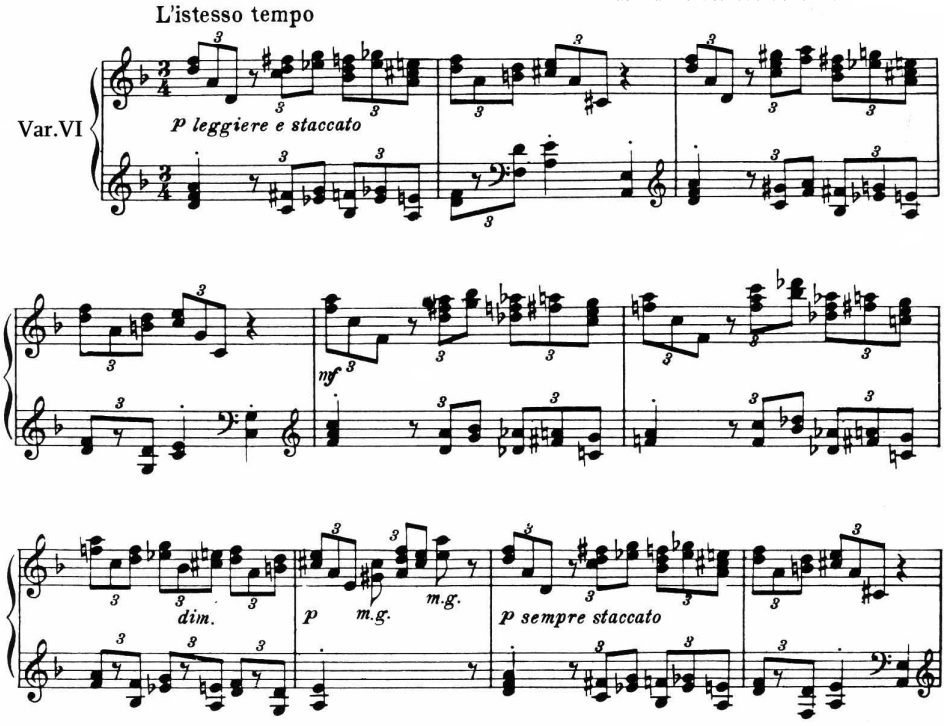
[Rachmaninov Variations on a Theme of Corelli, Op. 42: VII. Variation 6. L'istesso tempo]
[코렐리 변주곡 - 변주 6]
Vladimir Ashkenazy: Yeah? This is another scherzando-variation. Uhm, and yet another one.
블라디미르 아쉬케나지 : 예? 여기 스케르찬도의 또 다른 변주가 있습니다. 그리고 또 하나.

[Rachmaninov Variations on a Theme of Corelli, Op. 42: XVIII. Variation 16. Allegro vivace]
[코렐리 변주곡 - 변주 16]
Vladimir Ashkenazy: And, and so on. Uhm, uhm, but they, the slow variations are very important, in the sense that, of course, the tune is slow... and the composer by his intuition, by his very strong inner artistic sense, of course, brings us back to the melancholy of the tune all the time in between this drama and the drive of the fast variations, and there is even an intermezzo.
블라디미르 아쉬케나지 : 그리고 기타 등등, 그러나 느린 변주들은 물론 곡이 느리다는 점에서 매우 중요하며... 작곡가는 강한 예술적 경향(감수성)을 통해 본능적으로(직관력과 타고난 예술적 감각이 매우 강하여) 우리에게 항상 멜로디(주제)의 우울함을 다시 불러일으키죠. 항상 드라마와 빠른 변주들의 템포 사이에는 간주(인터메조)가 있습니다.

[Rachmaninov Variations on a Theme of Corelli, Op. 42: XV. Intermezzo]
[코렐리 변주곡 - 간주]
Vladimir Ashkenazy: This intermezzo brings us back to the tune and then, with wonderful inventiveness, Rachmaninoff’s... Rachmaninoff gives us the tune in the major key. That’s the only major key episode in the variation. Like, if there is a... not a glimmer of hope, because I don’t think it’s a hopeful episode but a f... a feeling of warmth, ah, it is this. What’s interesting to note is it at the end of this sequence, Rachmaninoff brings us back, in spite of some work, brings us back to the frozen ice of the original tune and to be a little bit more technical, ac... actually brings us back to the D minor. So this happens here. And here we are back in D minor.
블라디미르 아쉬케나지 : 이 인터메조는 우리를 멜로디로 되돌리며(주제로 이끈 다음), 놀라운 독창성으로 라흐마니노프가 장조의 주제를 제공합니다. 이것은 이 변주곡에서 유일한 장조 에피소드입니다. 한 줄기 희망이 없다면, 희망적인 에피소드가 아니라 따뜻함을 느끼는 에피소드이기 때문에 이것이... (마치 희망이 없는 것처럼, 그게 이 에피소드의 아이디어가 아니라, 이런 따뜻한 느낌인 거죠.) 놀라운 점은 이 시퀀스(동형 진행, 반복)가 끝날 무렵 라흐마니노프가 약간의 따뜻함에도 불구하고 원래 멜로디의 얼어붙은 차가운 느낌으로 돌아가, 엄밀히 (기술적인 측면에서) 말하면, d단조로 되돌아간다는 것입니다. 이것은 여기에서 발생하죠. 그리고 여기에 또 d단조가 있군요. (여기서 우리는 d단조로 돌아갑니다.)
.jpg)
[Rachmaninov Variations on a Theme of Corelli, Op. 42 - XVI. Variation 14. Andante (come prima)]
[코렐리 변주곡 - 변주 14]
Vladimir Ashkenazy: And the touch of lyricism that happens here is very special, I think.
블라디미르 아쉬케나지 : 그리고 여기서 일어나는 서정적인 느낌(그 감성의 터치)은 매우 특별하다고 생각합니다.

[Rachmaninov Variations on a Theme of Corelli, Op. 42: XVII. Variation 15. L'istesso tempo]
[코렐리 변주곡 - 변주 15]
Vladimir Ashkenazy: Ah, in this little episode, I, I don’t think he’s going out to the world to see how beautiful life is. It’s not the intention and there is no... no inner need somehow at that time in his life. He didn’t feel like this. So I think it’s just the warm, touching episode enclosed, somehow not really open, but, uhm, it’s very telling in a way. Uhm, interesting when I think of the composition of the variation, of this set, is that it is basically roughly speaking, it’s slow... then, uhm, uhm, very roughly speaking, there’s a fast set of variations, then it comes to a very long, slow episode which is beginning with the intermezzo. All this and the lyrical tune. Then it goes fast again, and in the end, after all the tragedy and the drama, and everything, ah, the composer brings us back to a very eloquent coda, which I think is important too. Here we hear the tune again.
블라디미르 아쉬케나지 : 이 작은 에피소드에서 저는 그가 인생이 얼마나 아름다운지 보기 위해 세상에 나가는 것이라고(거기에 가고 있다고) 생각하지 않아요. 그것은 의도가 아니며 그는... 그의 인생에서 현재로서는 내면의 욕망이 없거든요. 그런 느낌이 아니라서 어디선가 닫혀 있고, 실제로 열리지는 않지만 뭔가 의미심장한, 따뜻하고 감동적인 에피소드인 것 같아요. 이러한 변주곡의 구성에 대해 생각할 때 흥미로운 점은 기본적으로 느리다는 것인데... 대략 말하자면, 빠른 변주들이 나온 다음 인터메조로 시작하는 매우 길고 느린 에피소드에 이르거든요. 이 모든 것과 감정이 풍부한 선율(서정적인 주제)가 나옵니다. 그런 다음 다시 속도가 빨라지며, 결국 비극과 드라마가 끝난 후 작곡가는 매우 설득력이 있는 코다(피날레)로 우리를 다시 데려오는데, 이것은 매우 중요하다고 생각합니다. 여기서 우리는 멜로디(주제)를 다시 듣죠.

[Rachmaninov Variations on a Theme of Corelli, Op. 42: XXIII. Coda. Andante]
[코렐리 변주곡 - 코다]
Vladimir Ashkenazy: And, ah, when you look at the whole set of variations, there’s an arc from the very melancholy tune in the beginning... and then. Um, you don’t think anymore about that legend [of the] shepherd who was hopelessly in love. It’s much more important than just one love story. I think this is, this is in a way, Rachmaninoff gives us his life, how tragic his life was, how hopeless it was, it is at that moment, and in a way – although he doesn’t, doesn’t anymore give generously as he did in his early period, but he shares his innermost thoughts with us. So from [the] tragedy of one lover comes [the] tragedy of life, of one individual, and a very wonderful individual. Perhaps it’s Rachmaninoff’s most eloquent composition and most revealing about his innermost feelings.
블라디미르 아쉬케나지 : 그리고 변주곡 전체를 보면 초반에 아주 애절한 멜로디의 이음줄이 나오는데... 그런 다음... 이제 아무런 희망 없이 사랑에 빠진 양치기의 전설을 완전히 잊었어요. (필사적으로 사랑에 빠진 양치기의 전설은 더 이상 생각나지 않아요.) 단순한 사랑 이야기보다 훨씬 더 중요하죠. 어떤 면에서 라흐마니노프는 우리에게 그의 삶이 얼마나 비극적이었고, 그 순간이 얼마나 절망적이었는지, 그리고 어떤 면에서는 - 비록 그가 더 이상 초기 단계만큼 관대하지 않더라도(처음 시작할 때처럼 후하게 베풀지 않지만), 그는 여전히 자신의 가장 깊은 생각을 공유합니다. 그래서 사랑에 빠진 남자(한 연인)의 비극에서 한 개인의 삶의 비극, 그리고 놀라운 개인의 치명적인 비극으로 이어지죠. 이 곡은 어쩌면 라흐마니노프 내면의(그의 가장 깊은) 감정을 가장 잘 표현(반영)하는(드러내는) 그의 가장 설득력 있는 작품일 것입니다.
[Vladimir Ashkenazy: Rachmaninov Variations on a Theme of Corelli, Op. 42]
- I. Theme. Andante
- II. Variation 1. Poco piu mosso
- III. Variation 2. L'istesso tempo
- IV. Variation 3. Tempo di Minuetto
- V. Variation 4. Andante
- VI. Variation 5. Allegro (ma non tanto)
- VII. Variation 6. L'istesso tempo
- VIII. Variation 7. Vivace
- IX. Variation 8. Adagio misterioso
- X. Variation 9. Un poco piu mosso
- XI. Variation 10. Allegro scherzando
- XII. Variation 11. Allegro vivace
- XIII. Variation 12. L'istesso tempo
- XIV. Variation 13. Agitato
- XV. Intermezzo
- XVI. Variation 14. Andante (come prima)
- XVII. Variation 15. L'istesso tempo
- XVIII. Variation 16. Allegro vivace
- XIX. Variation 17. Meno mosso
- XX. Variation 18. Allegro con brio
- XXI. Variation 19. Piu mosso. Agitato
- XXII. Variation 20. Piu mosso
- XXIII. Coda. Andante
[블라디미르 아쉬케나지 - 라흐마니노프 <코렐리의 주제에 의한 변주곡> 전곡]

우연히 확보한 영어 자막에다가 메디치 TV에서 확보한 독일어, 스페인어, 프랑스어, 이탈리아어 자막을 절충하여 번역했다. 열심히 받아쓴 영어 자막이라도 도중에 삭제를 고려했다. 영어 문장이 지저분한 것도 있었고, 정확성을 추구하려면 차라리 번역본이 나을 때도 있다. 이전에 정리한 동영상과 일부가 겹친다. 독일어를 번역하면서 영어 자막을 일부 수정하기도 했다. 외국 분한테 대충 해서 드릴 순 없고 내 영어 듣기 능력도 키워야 해서 몇 번 더 검토해서 영어 자막을 정리해나갔다. 유튜브를 통해 단지 다큐멘터리가 아니라 DVD 영상이라는 것도 알게 되어서 관련 자료들을 더 찾았다. 총 160분이지만 영상을 2개(90분)만 가지고 있고 나머지 2개는 나한테 없다. 독일어 자막은 싱크가 맞는데 프랑스어에서 틀어져서 독일어 자막을 텍스트 파일로 변환한 다음 시간대를 고쳤다. 이탈리아어와 스페인어도 하다가 멈추고 안 했는데 시간대를 훑어보고 난 다음 동영상에 자막을 넣고 재생해보니 미묘하게 차이 날 뿐이지 지장이 없어서 프랑스어만 고쳤다. 결국 스페인어에서도 타이밍이 늦는 게 감지되어 이탈리아어 자막과 싱크를 맞췄다. 쇼팽 소나타 3번 4악장이 끝나갈 때 쇼팽 콩쿠르의 한 장면을 느꼈다. 베토벤의 황제 협주곡을 예행연습하는 모습에서는 온 힘을 다해 연주하는 게 인상 깊었다. 코렐리 변주곡 동영상에서는 스페인어 자막이 나오는 타이밍이 살짝 느렸는데 다행히 지장은 없어서 그대로 뒀다. 다행히 스페인어 자막을 토대로 외국 분이 영어 자막을 다듬어주셨다. 구글링으로 알게 되었는데, 아쉬케나지가 2014년에 러시아 국적 취득 절차를 밟았다는 기사가 있었다.


